NBC
Office address
National Engineering Industries Ltd.
Khatipura Road Jaipur – 302006 Rajasthan, India
Phone Number

Toll Free: 1800 3000 6222
Telephone: +91 141 222 3221
Fax: +91 141 222 1926, 222 2259
CIN: U29130WB1946PLC013643

Bearings Used in Electric Motors: An Engineer’s Selection Guide

Understanding which bearings are used in electric motors — and why — directly determines whether a motor delivers 40,000 hours of reliable operation or fails after just 4,000. Across industries such as cement manufacturing in Rajasthan, mining operations in Jharkhand, and automotive assembly plants in Pune, the pattern is familiar: a motor fails unexpectedly, production stops, and troubleshooting begins. In most cases, the root cause traces back to bearing failure. This guide explains the major bearing types used in electric motors, how to select the right bearing for specific applications, and how to maximise bearing life in demanding industrial environments.

What Does a Bearing Do in an Electric Motor?

Motor bearings perform three critical mechanical functions:
  • Support the rotor shaft both radially and axially, maintaining precise air-gap alignment between the rotor and stator 
  • Reduce friction between rotating and stationary components, minimising heat generation and energy loss 
  • Absorb static and dynamic forces generated by belts, couplings, vibration, and operational loads 
Without the correct bearing arrangement, even a properly designed motor can experience excessive vibration, overheating, reduced efficiency, and premature failure.

Types of Bearings Used in Electric Motors

  1. Deep Groove Ball Bearings — The Industry Standard
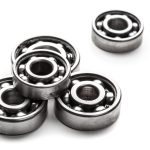
Deep groove ball bearings are the most widely used bearings in electric motors worldwide. Their design allows them to handle both radial loads and moderate axial loads while operating efficiently across a broad speed range. Why Engineers Prefer Them
  • Low friction and excellent high-speed performance 
  • Suitable for operating speeds from 1,500 to 30,000 RPM 
  • Available in sealed (2RS) and shielded (ZZ) configurations 
  • Cost-effective and widely interchangeable under ISO 15 standards 
  • Easily available from major bearing manufacturers 
Typical Applications General industrial motors, pumps, fans, compressors, and HVAC systems. Real-World Example A 110 kW induction motor driving a cement kiln cooling fan in Gujarat commonly uses 6319-2RS deep groove ball bearings at both ends. The sealed design helps prevent cement dust contamination — one of the leading causes of premature failure in such environments.
  1. Cylindrical Roller Bearings — For Heavy Radial Loads
When radial load requirements exceed the capability of ball bearings, cylindrical roller bearings become the preferred choice. Their line-contact design distributes load across a larger surface area, providing significantly higher radial load capacity. Common Configurations
  • NU Type — Axially free; commonly used as the floating bearing at the non-drive end (NDE) 
  • NJ Type — Provides axial location in one direction; often used at the drive end (DE) 
  • N Type — Fully floating arrangement for pure radial loading 
Advantages
  • High radial load capacity 
  • Reduced friction under heavy loads 
  • Suitable for large belt-driven motors 
Real-World Example A 500 kW slip-ring induction motor in a coal handling plant may use NU 320 ECM cylindrical roller bearings to support heavy radial loads generated by V-belt drives.
  1. Angular Contact Ball Bearings — For Combined Loads
Angular contact ball bearings are designed to handle combined radial and axial loads simultaneously. Their contact angle geometry enables higher thrust load capacity compared to standard deep groove ball bearings. These bearings are typically installed in matched pairs using either:
  • Face-to-face (O arrangement) 
  • Back-to-back (X arrangement) 
Typical Applications Pump motors, vertical motors, and high-speed applications with thrust loading. Real-World Example Submersible borewell pump motors used in agricultural irrigation systems across Rajasthan commonly use paired angular contact bearings to withstand rotor weight and upward hydraulic thrust simultaneously.
  1. Spherical Roller Bearings — For Misalignment and Heavy Loads
Spherical roller bearings are ideal where shaft deflection, housing misalignment, or severe operating loads are expected. Their self-aligning design accommodates angular misalignment while maintaining high load-carrying capability. Advantages
  • Handles heavy radial and axial loads 
  • Accommodates shaft misalignment 
  • Suitable for harsh industrial environments 
Real-World Example A 2 MW synchronous motor driving a raw mill in a cement plant may use spherical roller bearings because foundation movement and shaft deflection make self-alignment critical for long-term reliability.
  1. Tapered Roller Bearings — For High Axial Thrust
Tapered roller bearings are used when axial thrust loads are dominant. Their geometry provides excellent thrust-handling capability while also supporting radial loads. These bearings are always installed in opposing pairs and require precise preload adjustment during assembly. Typical Applications
  • Gearbox-coupled motors 
  • Crane hoist motors 
  • Railway traction motors 
Real-World Example Traction motors used in Indian Railways WAP-7 locomotives rely on tapered roller bearings to absorb heavy axial forces during acceleration and braking.
  1. Sleeve Bearings — For Large, Low-Speed Motors
For very large motors — typically above 1 MW — sleeve bearings (journal bearings) are often preferred over rolling element bearings. Instead of rolling elements, the shaft rotates on a thin pressurised oil film inside the bearing sleeve. Advantages
  • Extremely long operating life 
  • Excellent damping characteristics 
  • Suitable for continuous-duty heavy machinery 
Limitations
  • Requires a dedicated oil lubrication system 
  • More complex maintenance requirements 
Under proper lubrication conditions, sleeve bearings can operate reliably for 10–20 years before major maintenance is required.

How to Select the Right Bearing for an Electric Motor

Bearing selection involves far more than matching shaft diameter. Engineers should evaluate the following parameters carefully:
Selection Factor What to Evaluate
Load Type Radial, axial, or combined loading
Load Magnitude L10 bearing life calculations per ISO 281
Operating Speed Bearing speed ratings and thermal limits
Misalignment Shaft deflection and housing accuracy
Lubrication Grease vs oil lubrication requirements
Temperature Ambient and operating temperatures
Environment Dust, moisture, and chemical exposure
VFD Operation Need for insulated or hybrid bearings
 

Common Causes of Electric Motor Bearing Failure

According to industry technical studies, the leading causes of premature bearing failure include:
  1. Lubrication Failure (~36%)
Incorrect grease quantity, wrong lubricant selection, or missed relubrication intervals.
  1. Improper Mounting (~16%)
Incorrect installation methods, poor shaft fits, or misalignment during assembly.
  1. Contamination (~14%)
Ingress of dust, water, or process chemicals into the bearing.
  1. Electrical Erosion (Fluting)
Stray shaft currents from variable frequency drives (VFDs) damaging bearing raceways.
  1. Overloading
Using bearings that are undersized for actual operating conditions.

VFD-Driven Motors: Special Bearing Requirements

Modern variable frequency drives generate high-frequency shaft voltages that can discharge through motor bearings, causing electrical pitting and fluting. Without protection, bearing life can reduce dramatically. For motors above 75 kW operating on VFDs:
  • Use electrically insulated bearings at the non-drive end 
  • Install shaft grounding rings 
  • Consider hybrid ceramic bearings for motors above 100 kW 
The cost of upgraded bearings is minimal compared to the cost of unplanned downtime.

Electric Motor Bearing Lubrication Best Practices

To maximise bearing service life:
  • Fill bearing housings to only 30–50% of free volume 
  • Use lithium-complex grease (NLGI Grade 2 or 3) for most industrial applications 
  • Follow manufacturer-recommended relubrication intervals 
  • Avoid mixing incompatible grease types 
  • Continuously monitor oil condition in sleeve-bearing systems 
Overgreasing remains one of the most common maintenance mistakes in industrial motors.

Conclusion:

Deep groove ball bearings remain the standard solution for most industrial electric motors due to their versatility, efficiency, and cost-effectiveness. However, application-specific requirements often demand specialised solutions:
  • Cylindrical roller bearings for heavy radial loads 
  • Angular contact bearings for combined loading 
  • Spherical roller bearings for misalignment conditions 
  • Tapered roller bearings for high thrust applications 
  • Sleeve bearings for large continuous-duty motors 
For VFD-driven motors, insulated or hybrid ceramic bearings are increasingly becoming essential for preventing electrical damage and extending service life. A structured bearing selection process — combined with correct lubrication, installation, and monitoring practices — significantly improves motor reliability and reduces lifecycle cost.

Frequently Asked Questions (FAQs)

Q1: What is the most commonly used bearing in electric motors?

Deep groove ball bearings are the most commonly used bearings in electric motors because they support both radial and moderate axial loads while operating efficiently across a wide speed range.

Q2: Why do VFD-driven motors require special bearings?

Variable frequency drives generate shaft voltages that can pass through standard bearings, causing electrical erosion and fluting. Insulated or ceramic hybrid bearings help prevent this damage.

Q3: What is the difference between drive-end and non-drive-end bearings?

The drive-end (DE) bearing typically acts as the locating bearing and handles both radial and axial loads. The non-drive-end (NDE) bearing usually allows axial thermal expansion of the shaft.

Q4: How long should electric motor bearings last?

Under correct operating conditions, motor bearings are typically designed for an L10 life of 20,000–40,000 operating hours.

Q5: Can any grease be used for motor bearings?

No. Motor bearing grease must match the application’s speed, load, and temperature requirements. Using the wrong grease or mixing incompatible greases can cause premature failure.>

Market Segments