
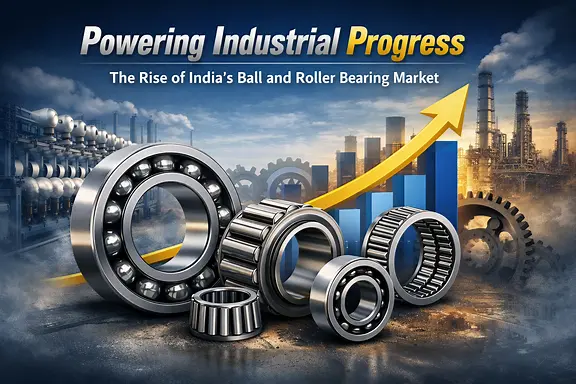
India’s growth story is unfolding across highways, manufacturing plants, railway networks, renewable energy parks, and modern industrial hubs. While large infrastructure projects and heavy machinery often capture the spotlight, a critical component quietly enables this progress behind the scenes — ball and roller bearings.
These precision-engineered components ensure smooth motion, reliability, and efficiency in machines across industries. By reducing friction and supporting controlled motion, bearings play a fundamental role in maintaining the performance and longevity of mechanical systems.
As India strengthens its position as a global manufacturing hub, the country’s bearing industry is experiencing significant growth driven by industrial expansion, technological advancement, and increasing global demand.
Industries ranging from automotive and railways to renewable energy and heavy manufacturing depend heavily on reliable bearing solutions. Without these components, machines would experience excessive wear, higher energy losses, and frequent breakdowns.
As a result, bearings play a crucial role in supporting India’s journey toward industrial development, infrastructure growth, and global competitiveness.
Bearings: The Unsung Enablers of Industrial Motion 
At their core, bearings reduce friction between moving components and support rotational or linear motion. However, in modern industrial applications, their role goes far beyond basic motion support.
Today’s bearings must deliver:
High load-carrying capacity
Long operational life
Superior energy efficiency
Minimal maintenance and downtime
Reliable performance under extreme operating conditions
In modern engineering systems, bearing performance is evaluated using parameters such as dynamic load rating, fatigue life, lubrication regime, and operating temperature limits.
From automotive engines and railway axles to wind turbines and heavy industrial machinery, bearings are mission-critical components where reliability directly impacts operational continuity and safety.
A single bearing failure in large industrial equipment can lead to costly downtime, production losses, and safety risks. Therefore, industries rely on high-quality bearings designed to perform under demanding operating environments.
India’s Bearing Market: A Growth Story in Motion
Over the past decade, India’s bearing industry has evolved rapidly, supported by strong domestic demand and growing export opportunities. Industrial expansion, infrastructure development, and manufacturing growth are creating sustained demand for advanced bearing technologies.
Several key sectors are driving this market growth
Automotive and Electric Vehicle Expansion
India has emerged as the third-largest automobile market in the world, generating substantial demand for bearings across passenger vehicles, commercial vehicles, two-wheelers, and off-highway equipment.
With the rapid adoption of electric vehicles (EVs), the industry is witnessing increasing demand for high-precision, low-noise, and energy-efficient bearings designed specifically for electric drivetrains and high-speed motors.
These specialized bearings help improve efficiency, reduce vibration, and enhance overall vehicle performance.
Infrastructure Development and Railways
India’s large-scale investments in infrastructure — including metro rail systems, dedicated freight corridors, highways, and ports — are driving long-term demand for heavy-duty roller bearings capable of handling high loads and continuous operation.
The modernization and expansion of railway networks have further strengthened the need for reliable bearing technologies that can operate under demanding conditions.
Roller bearings used in rail and heavy industrial equipment must withstand high loads, continuous duty cycles, and harsh environmental conditions.
Industrial Manufacturing and Automation
As industries adopt automation, robotics, and smart manufacturing technologies, the demand for high-precision bearings with tight tolerances and consistent performance has increased significantly.
Bearings today play a critical role in equipment such as:
CNC machines
Industrial gearboxes
Robotics and automation systems
Material handling equipment
High-speed production machinery
The shift toward precision manufacturing is encouraging the development of advanced bearing solutions capable of supporting higher speeds, improved efficiency, and longer service life.
Renewable Energy and Power Generation
India’s ambitious renewable energy goals, particularly in wind and solar power, are creating new opportunities for the bearing industry.
Wind turbines operate under highly variable loads, harsh environmental conditions, and continuous duty cycles. Bearings used in these systems must deliver exceptional durability, corrosion resistance, and long operational life to ensure reliable power generation.
High-performance bearings help reduce maintenance costs and increase the reliability of renewable energy infrastructure.
Ball Bearings vs Roller Bearings: Serving Diverse Industrial Needs
The Indian bearing market continues to grow across both ball bearing and roller bearing segments, each designed to meet specific operational requirements.
Ball Bearings
Ball bearings are commonly used in applications requiring:
High rotational speeds
Low friction
Compact design
Typical applications include electric motors, pumps, fans, automotive components, and household appliances.
Their ability to operate efficiently at high speeds makes them ideal for light to medium load applications.
Roller Bearings
Roller bearings are designed to handle higher radial loads and demanding industrial environments.
These bearings are widely used in:
Industrial gearboxes
Construction and mining equipment
Heavy industrial drives
As industrial machinery becomes more sophisticated, industries increasingly demand application-specific bearing solutions rather than generic products.
Make in India: Strengthening Domestic Manufacturing

Government initiatives such as Make in India, Atmanirbhar Bharat, and the Production Linked Incentive (PLI) scheme have significantly strengthened domestic manufacturing capabilities in the bearing sector.
Indian bearing manufacturers are now:
Expanding production capacities
Investing in advanced manufacturing technologies
Improving material science and heat-treatment processes
Adopting global quality and testing standards
These efforts are gradually reducing import dependency while positioning India as a competitive exporter of high-quality bearings to global markets.
Technology and Innovation: Redefining Bearing Performance
Modern bearing manufacturing combines advanced metallurgy, precision engineering, and digital monitoring technologies to improve reliability and operational performance.
Key innovation trends shaping the industry include:
Advanced steel and alloy compositions for improved fatigue life
Optimized cage designs for higher speed and stability
Enhanced sealing systems for contamination protection
Precision grinding and surface finishing to reduce friction
Compatibility with condition monitoring and predictive maintenance systems
These technological advancements are helping industries extend equipment life, improve operational efficiency, and reduce total cost of ownership.
Global manufacturers such as SKF, Timken, and Schaeffler have also played an important role in advancing bearing technology and establishing global quality benchmarks.
The Growing Importance of the Bearing Aftermarket
Beyond OEM supply, the industrial aftermarket for bearings is expanding rapidly in India.
Industries such as cement, steel, mining, and power generation require regular bearing replacement and maintenance to ensure uninterrupted operations.
This has increased the importance of:
Application engineering support
Condition monitoring and predictive maintenance
Manufacturers that combine high-quality products with strong technical support are gaining increasing trust among industrial customers.
Exports and Global Competitiveness
India’s bearing industry is no longer limited to domestic consumption. Indian manufacturers are increasingly supplying bearings to international OEMs and aftermarket customers across Europe, Asia, Africa, and the Americas.
Key factors supporting export growth include:
Cost-effective manufacturing
Skilled engineering talent
Compliance with international quality standards
Capability to customize solutions for diverse applications
This growing global acceptance highlights India’s emergence as a reliable and competitive bearing manufacturing hub.
The Road Ahead: A Market Built for Momentum

India’s ball and roller bearing market is expected to witness sustained growth in the coming years.
Key growth drivers include:
Continued industrialization and infrastructure expansion
Rapid adoption of electric mobility
Expansion of renewable energy capacity
Increasing focus on domestic manufacturing and exports
Continuous innovation in bearing design and materials
As machines become faster, smarter, and more efficient, the importance of precision components like bearings will only continue to grow.
Conclusion: Supporting India’s Progress, One Rotation at a Time

The rise of India’s bearing industry reflects the nation’s broader journey toward engineering excellence, manufacturing self-reliance, and global competitiveness.
At the center of this progress are precision components that quietly enable motion, reliability, and efficiency across industries.
With strong manufacturing capabilities, advancing technology, and a commitment to quality, India is well positioned to power the next generation of industrial growth.
And as the country continues to move forward, the silent rotation of bearings will remain essential in driving machines—and industries—around the world.