Categories
Blog

How Advanced Materials Improve Bearing Performance in Extreme Aerospace Conditions

How Advanced Materials Improve Bearing Performance in Extreme Aerospace Conditions

Introduction

Aerospace systems operate in some of the harshest environments in engineering. Bearings used in aircraft engines, landing gear assemblies, flight control actuators, satellite mechanisms, and space equipment must endure rapid temperature fluctuations, extreme loads, intense vibration, near-vacuum conditions, and long duty cycles. Traditional materials often fail under these stresses, making advanced materials essential for designing reliable, high-performance aerospace bearings.

Material science directly impacts reliability, safety, energy efficiency, and service life in aerospace engineering. Stronger, lighter, and more stable materials allow bearings to perform consistently, even under severe stress.
Advanced Materials in Aerospace Bearings

What Makes Aerospace Bearings Unique

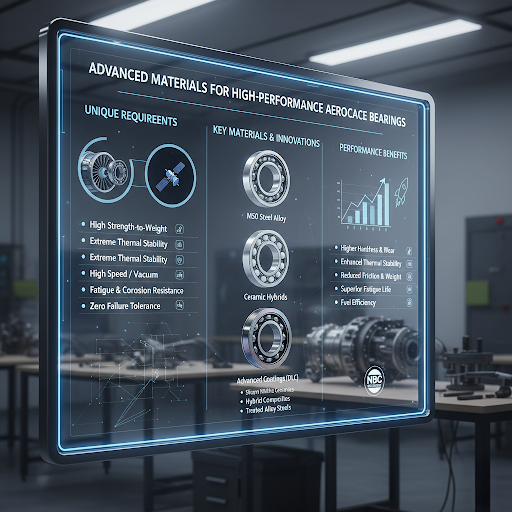
Aerospace bearings differ significantly from standard industrial bearings due to their demanding environment. They must provide:

  • High strength-to-weight ratio

  • Precise operation under heavy and fluctuating loads

  • Exceptional thermal stability

  • Resistance to fatigue and corrosion

  • Smooth performance at high rotational speeds

  • Reliable function when lubrication is limited

  • Zero tolerance for failure

Even a minor failure can compromise mission safety, emphasizing the importance of advanced material systems.

Challenges in Extreme Aerospace Conditions

Aerospace bearings face unique challenges that make material selection critical:

  • Extreme temperature changes: Components may experience sub-zero temperatures at high altitudes and extremely high temperatures in jet engines.

  • High-speed rotation: Engine bearings rotate at very high speeds, generating substantial centrifugal forces.

  • Vacuum or near-vacuum environments: Space applications limit lubrication availability, increasing the need for thermal stability.

  • High vibration loads: Continuous vibration and shock require fatigue-resistant materials.

  • Corrosion risk: Exposure to hydraulic fluids, humidity, atmospheric chemicals, and jet fuel can degrade standard materials.

  • Frequent cyclic stresses: Repeated acceleration, deceleration, and directional changes place heavy fatigue loads on bearings.

These conditions make careful material selection one of the most important design decisions in aerospace engineering.

How Advanced Materials Enhance Aerospace Bearing Performance

How Advanced Materials Enhance Aerospace Bearing Performance

Advanced materials improve bearing performance by offering:

  • Higher hardness and wear resistance

  • Improved dimensional stability under temperature changes

  • Low friction characteristics

  • Higher fatigue strength

  • Better load distribution

  • Corrosion resistance

  • Lower density for improved fuel efficiency

Selecting the right material allows manufacturers to design bearings that operate reliably for longer periods, even in extreme environments.

Key Advanced Materials Used in Aerospace Bearings

  • High-purity stainless steels: Provide excellent corrosion resistance and strong performance at moderately high temperatures.

  • M50 and M50 NIL steels: Widely used aerospace steel grades offering high strength, thermal stability, and exceptional wear resistance.

  • Silicon nitride ceramics: Lighter, harder, and more heat-resistant than steel, reducing centrifugal forces and improving fatigue life.

  • Titanium alloys: Used where weight reduction and corrosion resistance are priorities.

  • Hybrid bearing materials: Combine steel races with ceramic balls for low friction, minimal thermal expansion, and high-speed capability.

  • Specially treated alloy steels: Advanced heat treatments enhance surface hardness and fatigue strength for reliable operation under heavy loads.

Benefits of Ceramic and Hybrid Bearings in Aerospace

Ceramic and hybrid bearings are increasingly popular due to their:

  • Lower density, reducing energy loss at high speeds

  • Superior thermal shock resistance

  • Minimal thermal expansion for stable performance

  • Higher fatigue life compared to steel

  • Reduced friction and heat generation

  • Lower lubrication requirements

  • Resistance to electrical arcing in aircraft systems

These characteristics make them ideal for jet engines, space mechanisms, and emerging electric aviation technologies.

Advanced Surface Treatments and Coatings

Surface engineering further enhances performance. Common aerospace treatments include:

  • Diamond-like carbon (DLC) coatings to reduce friction

  • Anti-wear coatings to prevent surface damage

  • Corrosion-resistant coatings for harsh environments

  • Thermal barrier coatings for extreme heat

  • Specialized heat treatments to improve strength and hardness

These technologies delay wear, prevent scoring, and stabilize bearing surfaces under stress.

NBC’s Capabilities in High-Performance Aerospace Bearings
NBC’s Capabilities in High-Performance Aerospace Bearings

NBC delivers advanced aerospace bearing solutions through:

  • Micron-level machining accuracy

  • Controlled heat treatment processes to enhance fatigue strength

  • Advanced metallurgy and material selection

  • Surface finishing technologies for smooth operation

  • Custom designs for high-temperature or high-speed environments

  • Testing systems that simulate real aerospace conditions

This combination of engineering skill and material expertise ensures reliable solutions for the most demanding aerospace applications.

Real-World Aerospace Applications

Advanced materials enable bearings to perform reliably in:

  • Jet engine shaft assemblies

  • Auxiliary power units

  • Landing gear systems

  • Flight control actuators

  • Helicopter transmissions

  • Satellite deployment and guidance mechanisms

  • Spacecraft reaction wheels

  • Precision navigation equipment

Each application relies on material strength, wear resistance, and thermal stability for flawless operation.

Future Trends in Aerospace Bearing Materials

The evolution of material science promises further advancements:

  • New ceramic materials with improved toughness

  • Self-lubricating materials suitable for space

  • Nano-engineered coatings to reduce friction

  • Lightweight composite metals

  • Smart materials that adapt to temperature changes

  • Materials tailored for electric aircraft and hypersonic vehicles

These innovations will continue to push aerospace performance boundaries.

Conclusion

Aerospace bearings face some of the most extreme operating conditions in engineering. Advanced materials are crucial to improving performance, reliability, and safety. Stronger alloys, ceramic technologies, hybrid materials, and precision heat treatments allow aerospace bearings to withstand high speed, intense heat, and challenging environmental conditions. Selecting the right material ensures a high-performance bearing with long life and consistent functionality, even under the harshest conditions.

Frequently Asked Questions

1. What makes an aerospace bearing different? It must operate reliably under high temperature, high speed, and high vibration conditions, with zero tolerance for failure.

2. Why are advanced materials essential for aerospace applications? They provide superior thermal stability, strength, corrosion resistance, and extended fatigue life.

3. Are ceramic bearings used in aerospace? Yes. Ceramic bearings are used for high-speed, low-friction, and high-temperature applications.

4. How do coatings improve aerospace bearing performance? Coatings reduce friction, protect surfaces from wear, and enhance corrosion resistance.

5. What factors influence material selection for an aerospace bearing? Temperature range, load conditions, rotational speed, lubrication environment, and required service life.
Categories
Blog

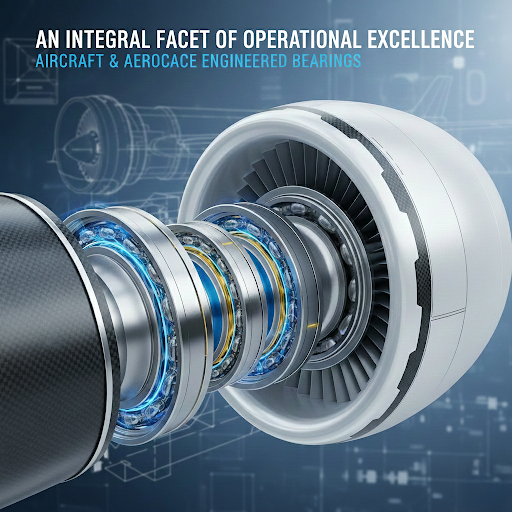
An Integral Facet of Operational Excellence: Aircraft & Aerospace Engineered Bearings

Aerospace bearings

In the aerospace industry, every component matters. Whether it’s a commercial jet, a military aircraft, or a space-bound system, precision and reliability are non-negotiable. Among the countless parts that keep an aircraft safe and efficient, engineered bearings play a quiet but extraordinary role. They support smooth movement, manage extreme loads, and ensure critical systems function exactly as intended — every single time.

For NBC Bearings, delivering world-class aerospace bearings isn’t just engineering. It’s a commitment to safety, performance, and the future of aviation.

Why Aerospace Bearings Matter

Aircraft systems operate in conditions far tougher than any industrial environment. Bearings must perform reliably under:

  • Extreme temperatures inside engines
  • High dynamic loads during takeoff, landing, and turbulence
  • High-speed rotations in turbines and actuators
  • Severe vibrations across the airframe

Standard bearings simply cannot survive these conditions. Aerospace bearings, however, are engineered with specialized materials, coatings, and manufacturing precision to maintain stability and performance in the harshest environments.

How Bearings Influence Aircraft Performance

How Bearings Influence Aircraft Performance

1. Reliability in Critical Systems

Aerospace bearings directly support essential functions such as:

  • Engine and turbine operation
  • Flight controls (ailerons, elevators, rudders)
  • Actuation systems
  • Landing gear deployment
  • Navigation and instrumentation

A single bearing malfunction can compromise safety. Robust bearing performance ensures reliability throughout the aircraft’s life cycle.

2. Reduced Friction & Improved Fuel Efficiency

Efficient bearings minimize friction across rotating parts, resulting in:

  • Better fuel economy
  • Lower heat generation
  • Reduced wear and tear
  • Longer service intervals

In an industry where every kilogram of fuel matters, this advantage is significant.

3. Lightweight Yet High-Strength Engineering

Modern aerospace design prioritizes lower weight without compromising strength. Engineered bearings balance high load-carrying capacity with lightweight construction, supporting overall aircraft efficiency.

Where Aerospace Bearings Are Used

1. Aircraft Engines

Bearings in engines face the most punishing conditions. They are used in:

  • Turbofan and turboprop engines
  • Turbochargers
  • Auxiliary Power Units (APUs)

They ensure high-speed stability, manage extreme temperatures, and reduce vibration within the turbine assembly.

2. Flight Control Systems

Precision bearings support the smooth and responsive movement of:

  • Ailerons
  • Elevators
  • Rudders

Their low-friction design ensures accurate pilot control and aircraft stability.

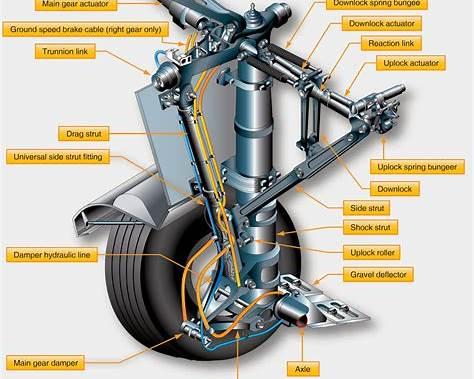
3. Landing Gear

Landing gear bearings must handle:

  • Massive impact forces on touchdown
  • Abrupt acceleration and deceleration
  • Corrosion from environmental exposure

Special coatings and materials ensure durability and consistent performance.

4. Actuation Systems

Bearings in electromechanical and hydraulic actuators support:

  • Flap and slat deployment
  • Brake systems
  • Gearbox components

In these systems, even the slightest tolerance variation can affect safety, making precision essential.

5. Cabin & Auxiliary Systems

Even non-flight-critical systems rely on engineered bearings, including:

  • Seating assemblies
  • Air-conditioning units
  • Cargo handling mechanisms

These ensure operational comfort and overall aircraft efficiency.

Engineering That Sets Aerospace Bearings Apart

1. Advanced Materials

To survive extreme conditions, aerospace bearings commonly use:

  • High-chromium steel
  • M50 tool steel
  • Titanium alloys
  • Ceramic balls (in hybrid bearings)

These materials offer superior hardness, corrosion resistance, and fatigue strength.

2. Performance-Enhancing Coatings

Cutting-edge coatings boost durability and reduce lubrication needs:

  • PTFE / MoS? coatings for low friction
  • Chrome or DLC coatings for wear resistance
  • Anti-corrosion layers for longevity

3. Precision Manufacturing

Aerospace bearings undergo:

  • Ultra-fine grinding
  • Micron-level machining
  • Rigorous balancing tests
  • High-precision heat treatment

The result: unmatched accuracy and reliability.

4. Global-Standard Quality Testing

Aerospace bearings must meet stringent certifications such as:

  • AS9100
  • NADCAP
  • FAA / EASA requirements

Every bearing is tested for performance, safety, and traceability.

NBC Bearings: Advancing India’s Aerospace Capability

As one of India’s leading bearing manufacturers, NBC Bearings has built deep expertise in high-precision applications for the aerospace sector.

Our Strengths:

  • Specialized aerospace-grade ball, roller, spherical, engine, and actuator bearings
  • State-of-the-art R&D and simulation-based design
  • Strong metallurgical competence and advanced testing facilities
  • Customized solutions for OEMs based on load, temperature, and life-cycle needs
  • Zero-defect deliveries through global-quality processes

NBC’s engineering excellence makes it a trusted partner for both domestic and global aerospace manufacturers.

Driving Operational Excellence in the Sky

As aircraft become more advanced — with electrification, automation, and lightweight engineering — the role of precision bearings becomes even more crucial. Their influence extends far beyond mechanical rotation: they impact sustainability, safety, efficiency, and operational longevity.

At NBC Bearings, we are committed to delivering aerospace-grade components that meet the highest global standards — supporting safer skies and future-ready flight systems.

Conclusion

Engineered aerospace bearings are far more than mechanical parts. They are silent enablers of flight safety, fuel efficiency, and operational excellence. Their ability to operate flawlessly under extreme conditions makes them indispensable in the aviation ecosystem.

With robust engineering, cutting-edge technology, and a legacy of precision, NBC Bearings continues to strengthen India’s foothold in global aerospace manufacturing — ensuring performance you can trust, flight after flight.

Categories
Blog

Bearings Role in Aerospace Engineering

Aerospace engineering is a realm where human ingenuity meets the vast expanse of the cosmos, propelling us beyond the realms of Earth’s atmosphere and into the unknown. It’s a journey marked by bold exploration, technological marvels, and groundbreaking discoveries.

At the heart of this cutting-edge field lie precision-engineered bearings, playing a crucial role in the smooth operation and safety of aerospace systems. From powering supersonic jets to propelling spacecraft toward distant stars, these tiny yet mighty components are the silent guardians of our skyward ambitions, navigating the cosmos with unwavering precision and reliability.

Precision Engineering for Aerospace Industry

In the annals of history, aerospace engineering has witnessed remarkable achievements that have shaped the course of human progress. From the Wright brothers’ historic first flight at Kitty Hawk to the awe-inspiring sight of astronauts walking on the moon, each milestone stands as a testament to human determination and innovation.

As we venture further into the cosmos, with SpaceX and Chandrayaan to the prospect of commercial space travel, the role of precision bearings becomes even more critical. They are the invisible threads that weave together the fabric of our aerospace dreams, ensuring that each journey is a testament to human endeavor and achievement.

Why Are Aerospace Bearings in Demand?

The soaring demand for aerospace bearings reflects the relentless pursuit of excellence in the sky-high realm of aviation. Imagine the precision needed to navigate through turbulent skies or brave the fiery reentry of a spacecraft. Here reliability, precision, and durability are paramount. Therefore an aerospace bearings must

  • withstand extreme temperatures,
  • sustain high speeds,
  • endure heavy loads, and
  • survive corrosive environments,

all while maintaining precise functionality. These aerospace bearings are meticulously engineered to meet the stringent standards of the aerospace sector, where even the slightest deviation can have catastrophic consequences.

Recent headlines have underscored the critical role of aerospace bearings in the industry’s most ambitious endeavors. From the successful landing of Mars rovers to the groundbreaking advancements in hypersonic flight, these bearings have been the backbone of countless missions, ensuring smooth operations amidst the most unforgiving environments.

Consider SpaceX’s Falcon rockets, which have revolutionized space travel with their reusable design. Behind the scenes, aerospace bearings work tirelessly to support the intricate machinery that propels these rockets into the cosmos, enabling groundbreaking achievements like the historic Crew Dragon missions to the International Space Station, or closer home with Vikram Lander and the dark side of the moon expedition successfully achieved by ISRO.

In the fast-paced world of aviation, every second counts, and the demand for aerospace bearings has never been higher. Whether it’s powering next-generation fighter jets or propelling commercial airliners across continents, these bearings are the unsung heroes of modern aviation, ensuring safety, reliability, and efficiency at every altitude.

Future of Aerospace Industry with Precision Bearings:

As the aerospace industry continues to evolve and expand, the future holds exciting possibilities for precision bearings. Advancements in materials science, manufacturing techniques, and design optimization are driving innovation in aerospace bearings, leading to lighter, stronger, and more efficient systems.

With the rise of electric propulsion, autonomous flight, and space exploration, the demand for high-performance bearings capable of operating in extreme conditions will only grow.

Applications of Bearings in Aerospace Engineering:

Applications of Bearings in Aerospace Engineering
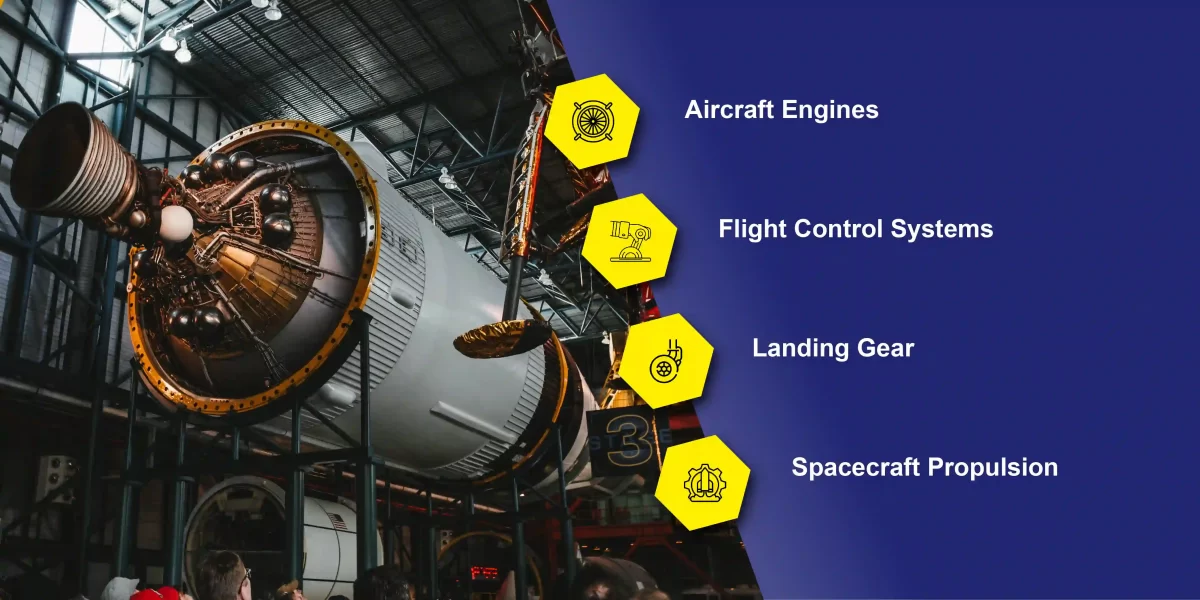
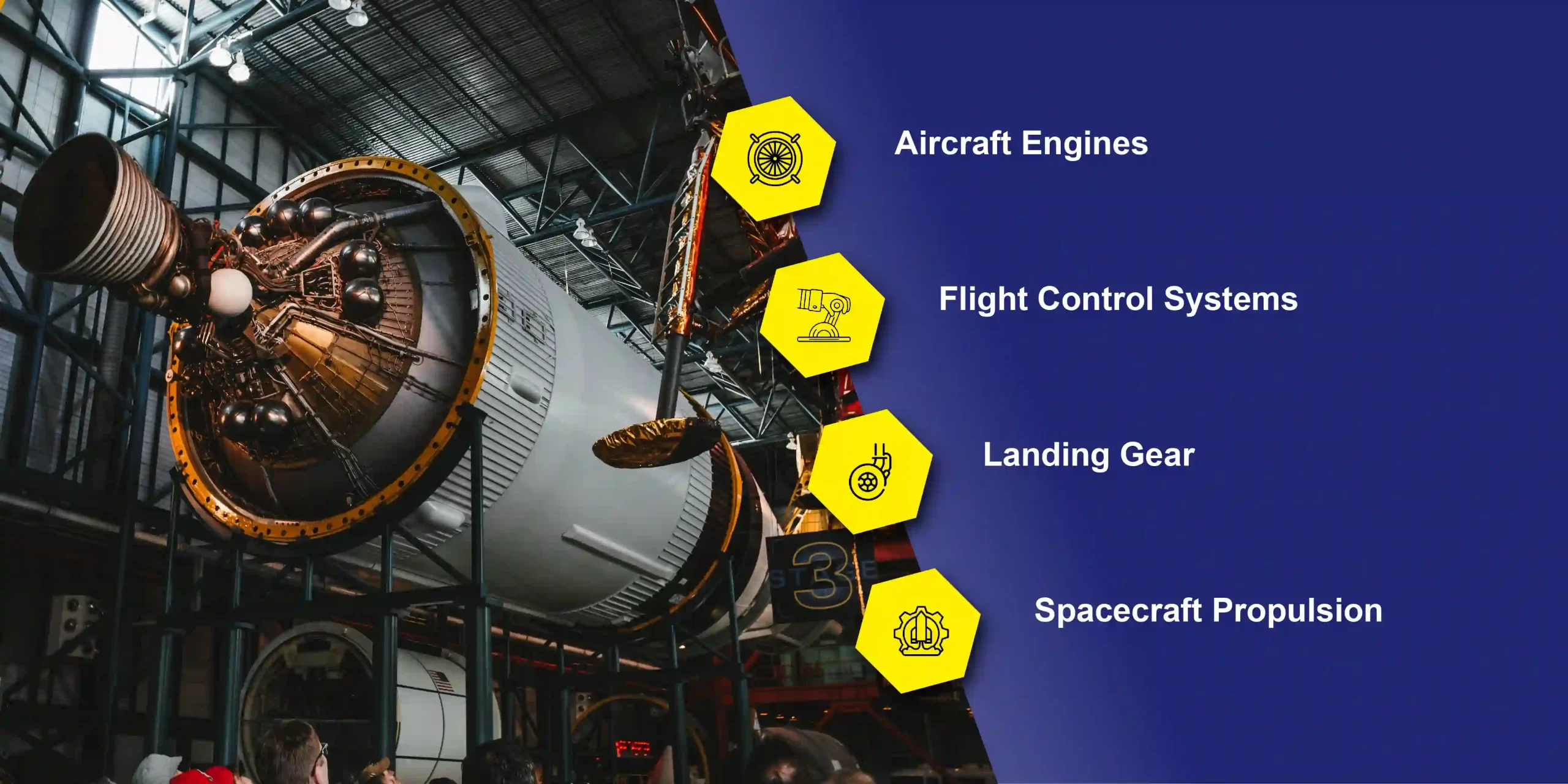
  • Aircraft Engines: Bearings support rotating components such as turbine blades and shafts, contributing to engine efficiency and reliability. Commonly used products are ball bearings, roller bearings, and tapered roller bearings.
  • Flight Control Systems: Bearings enable precise movement in control surfaces such as ailerons, elevators, and rudders, ensuring stable and responsive flight. Commonly used bearings in this case are: spherical plain bearings, rod end bearings, and ball bearings.
  • Landing Gear: Bearings in landing gear assemblies withstand immense loads during takeoff, landing, and taxiing, providing smooth operation and structural support. Commonly used bearings in this case are: tapered roller bearings, ball bearings, and roller bearings.
  • Spacecraft Propulsion: Bearings facilitate the movement of components in rocket engines and thrusters, essential for maneuvering and trajectory control. Most used bearings would be ball bearings, roller bearings, and thrust bearings.

In the dynamic and demanding world of aerospace engineering, precision bearings serve as unsung heroes, silently powering the advancement of human exploration and technology. As the aerospace industry ventures into new frontiers, from supersonic travel to interplanetary missions, the role of bearings will remain indispensable, ensuring the safety, reliability, and efficiency of aerospace systems for generations to come.

FAQ's

How do bearings contribute to aircraft engine performance?

Bearings support rotating components within aircraft engines, such as turbine blades and shafts, reducing friction and ensuring smooth operation, thereby optimizing engine performance.

What role do bearings play in aerospace flight control systems?

Bearings enable precise movement in aerospace flight control systems, ensuring stable and responsive aircraft maneuverability by facilitating the operation of control surfaces such as ailerons, elevators, and rudders.

How are bearings engineered for space exploration in spacecraft?

Bearings for space exploration are engineered to withstand the harsh conditions of space, including extreme temperatures, vacuum environments, and radiation exposure, while maintaining precise functionality for critical spacecraft systems.

Why is precision crucial in aerospace bearings?

Precision is crucial in aerospace bearings to ensure accurate alignment, minimal friction, and reliable performance under extreme conditions, ultimately contributing to the safety and efficiency of aerospace systems.

Are there specialized bearings for different aerospace applications?

Aerospace bearings must overcome challenges such as high temperatures, rapid temperature fluctuations, vacuum environments, high speeds, heavy loads, and exposure to corrosive substances, all of which can affect bearing performance and longevity.

What challenges do aerospace bearings face in extreme conditions?

Yes, aerospace bearings are tailored to specific applications and environments within the aerospace industry, with variations in materials, designs, and coatings to meet the unique requirements of aircraft engines, flight control systems, landing gear, and spacecraft propulsion systems.